


The client onboarding process is the structured sequence of steps that transforms a signed contract into an active, productive working relationship. A complete onboarding spans 12–15 steps and typically finishes within 7–14 days. The top 20% of service businesses complete this sequence in 5 days or fewer and experience significantly lower churn rates than firms with no structured process. The bottom 20% lose 25–35% of new clients within 90 days. That gap is not accidental. It reflects the difference between a repeatable system and a series of improvised emails.
What are the essential phases of a client onboarding process?
A professional onboarding workflow follows seven sequential phases. Each phase has a defined purpose, a timing window, and specific deliverables. Skipping or reordering phases is the single most common cause of scope creep and rework.
-
Welcome and portal access (Day 1). Send a welcome email within 24 hours of contract signing. Include login credentials for your client portal, a short orientation video or guide, and a clear outline of what happens next. The welcome phase is the highest-value touchpoint in the entire sequence. Clients form their lasting impression within the first 24–48 hours, so immediate value delivery is non-negotiable.
-
Discovery and intake (Days 1–3). Send the intake form immediately after the welcome message. Set an automated deadline of 3 days for completion. Manual follow-ups are less reliable and create inconsistent records.
-
Document collection (Days 2–4). Collect signed agreements, compliance documents, and any credentials the team needs. Use a centralized portal, not email threads. Portals timestamp every submission and make documents searchable.
-
Credentials and access setup (Days 3–5). Provision system access, logins, and permissions only after intake is complete. Starting this phase before intake creates dependency gaps that require rework later.
-
Kickoff call (Days 5–7). Align on goals, timelines, communication cadence, and success metrics. This call is a confirmation meeting, not a discovery session. Discovery should already be complete by this point.
-
Internal handoff (Days 6–8). Transfer all client context from the sales or account team to the delivery team. Use a standardized handoff document that covers client goals, known risks, and agreed deliverables.
-
First-week review (Days 10–14). Conduct a short check-in to confirm the client feels oriented and that no open questions remain. This review closes the formal onboarding phase and opens the ongoing engagement cycle.
Pro Tip: Set your intake form deadline as an automated reminder in your project management tool. Automated deadlines outperform manual follow-ups for client compliance every time.
How does automation improve accuracy and efficiency in onboarding?

Up to 60% of onboarding friction comes from administrative overhead and communication misalignment. That number is high enough to justify a serious look at where manual processes still exist in your workflow.
Automation addresses friction at three specific points:
- Intake form delivery and deadline enforcement. Automated intake systems send the form, track completion status, and trigger reminders without human intervention. This removes the most common source of delay in the first week.
- E-signature and document routing. E-signature tools eliminate the back-and-forth of PDF attachments sent by email. Documents are signed, timestamped, and stored in one location automatically.
- Centralized document management. Centralized portals prevent the problem of searching through email threads weeks later for a compliance document. Every file has a clear owner, a submission date, and a version history.
- CRM data entry. Manually copying client details from intake forms into a CRM is slow and error-prone. Tools that automate CRM data entry eliminate transcription errors and free up time for higher-value work.
The audit trail that automation creates also matters for compliance. When a client dispute arises, you need a timestamped record of every document submitted and every communication sent. Email threads do not provide that.
Pro Tip: Never collect compliance documents by email. Use a portal that timestamps every upload. If a document is ever questioned, you need a record that shows exactly when it arrived and who submitted it.
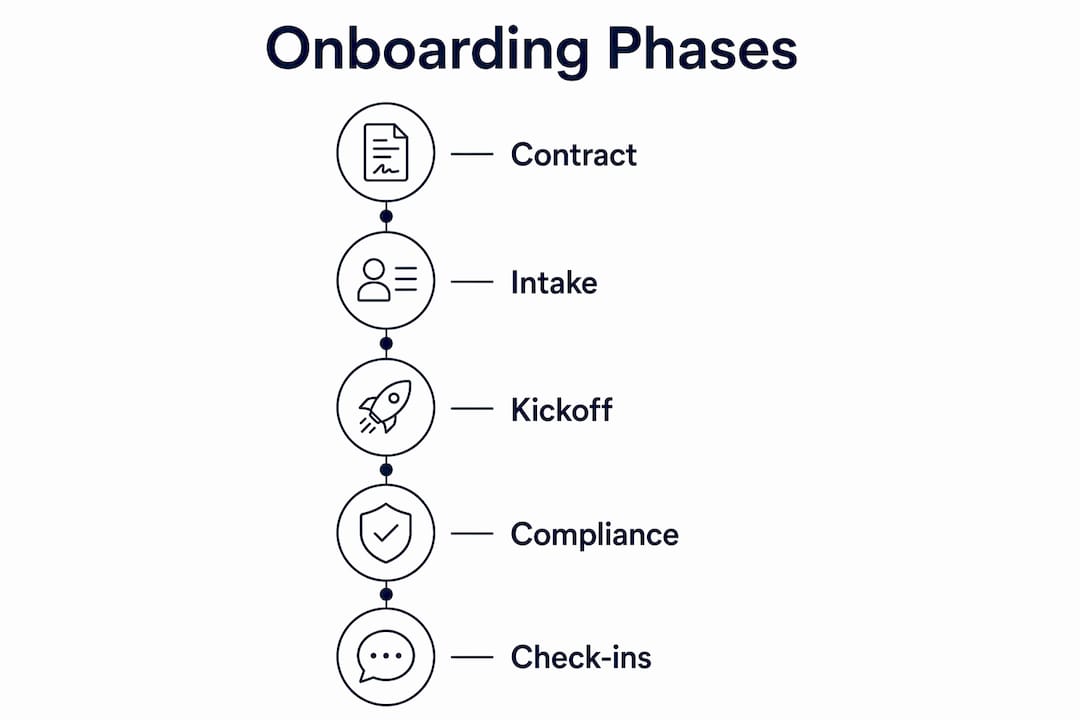
What best practices reduce churn and improve the client experience?
Effective onboarding is not just paperwork completion. It is relationship building with a structured backbone. The 5 Cs framework captures this well: Compliance, Clarification, Culture, Connection, and Confidence. Firms that address all five retain clients at higher rates than those focused only on administrative completion.
“Neglecting human elements damages client loyalty despite completing every admin step. Successful onboarding balances compliance and administrative completion with building cultural and emotional connection to foster confidence and loyalty.”
Here is how each element translates into practice:
- Compliance. Collect all required documents and signed agreements before delivery begins. No exceptions.
- Clarification. Confirm goals, success metrics, and communication expectations at the kickoff call. Write them down and share them with the client.
- Culture. Match your communication style to the client’s preferences. Some clients want weekly written updates. Others prefer a quick call. Ask early and document the answer.
- Connection. Assign a named point of contact on your team. Clients who know who to call feel more secure and escalate problems earlier, when they are still small.
- Confidence. Deliver something of value in the first week. A completed audit, a draft plan, or a research summary all signal that the work has started and the investment was sound.
Automated feedback loops at 30, 60, and 90-day milestones allow teams to catch small misunderstandings before they become project-threatening disagreements. Firms that skip these check-ins often see hidden disengagement emerge between months 4 and 9, long after the kickoff call is forgotten.
What common mistakes hinder onboarding effectiveness?
Most onboarding failures trace back to a small set of repeatable mistakes. Recognizing them is the first step to eliminating them.
- Starting delivery before intake is complete. This is the most expensive mistake in onboarding. Delivery work that begins without full intake information requires rework when the missing details arrive. Strict dependency sequencing prevents this. No phase should begin until its predecessor is fully closed.
- Using inconsistent communication channels. When some updates go by email, others by chat, and others by phone, clients lose track of what was agreed. Pick one primary channel and document it in the kickoff notes.
- Skipping the internal handoff. Sales teams know things about a client that delivery teams need. Without a formal handoff document, that context disappears. The delivery team then rediscovers it through client friction.
- Treating onboarding as a one-time event. Many firms believe onboarding ends at the kickoff call. Effective onboarding requires sustained engagement through the first 90 days. Clients who feel abandoned after the kickoff are the ones who churn quietly.
- Using vague checklists. A checklist that says “send welcome email” is less useful than one that says “send welcome email with portal login, orientation video link, and 3-day intake deadline.” Specificity removes ambiguity and makes accountability clear.
Pro Tip: Build your client onboarding checklist as a standard operating procedure with named owners for each task. When every step has an owner and a deadline, nothing falls through the gaps.
Key Takeaways
A structured client onboarding process, completed within 7–14 days and sustained through 90-day check-ins, is the most reliable way to reduce early churn and build lasting client relationships.
| Point | Details |
|---|---|
| Complete onboarding in 7–14 days | Top-performing firms finish in 5 days or fewer and experience measurably lower churn. |
| Use strict phase sequencing | Never begin delivery work until intake and credentials are fully collected. |
| Automate intake and document collection | Centralized portals with automated deadlines outperform manual email follow-ups. |
| Apply the 5 Cs framework | Address Compliance, Clarification, Culture, Connection, and Confidence for full retention impact. |
| Sustain engagement through 90 days | Schedule check-ins at 30, 60, and 90-day milestones to catch disengagement early. |
What I’ve learned from watching onboarding go wrong
Most onboarding failures I’ve seen share one trait: the team treated the kickoff call as the finish line. Everything before it got careful attention. Everything after it got none. The client felt the drop immediately, even if they couldn’t name it.
The counterintuitive truth is that the kickoff call is closer to the halfway point than the end. The real work of building trust happens in the weeks that follow, when the client is watching to see if your team delivers what was promised in that first meeting. A 30-day check-in that surfaces one small misalignment is worth more than any amount of polished onboarding documentation.
I’ve also seen firms invest heavily in automation and then wonder why clients still churn. Automation handles the administrative layer well. It does not replace the human judgment required to read a client’s tone in a check-in call and recognize that something is off. The best onboarding systems combine both: automated reminders and document routing on the back end, and a named human contact on the front end.
The firms that get this right treat onboarding as a living process. They review it quarterly, collect feedback from recently onboarded clients, and update their checklists based on what they find. The firms that struggle treat it as a fixed template from three years ago that nobody has touched since.
— Moe.
Textsbert cuts the data entry out of client onboarding
Onboarding generates a lot of form filling. Client details move from intake forms to CRM records, from signed agreements to billing systems, from portal registrations to project management tools. Every manual transfer is a chance for an error.

Textsbert eliminates that risk by autofilling browser forms, fillable PDFs, and Excel sheets using saved business details or copied text. Its PDF autofill feature handles compliance documents and intake forms without manual retyping. The Magical Auto Fill feature fills forms directly from copied text, so client data moves from email or document to form in seconds. All processing happens locally on your device, which means sensitive client data never leaves your machine. For teams managing high volumes of new client setup, Textsbert removes the repetitive work without removing the human review before submission.
FAQ
What is the standard timeline for client onboarding?
A professional client onboarding process spans 7–14 days and includes 12–15 steps. Top-performing firms complete the core sequence in 5 days or fewer.
What causes the most friction during client onboarding?
Administrative overhead and communication misalignment account for up to 60% of onboarding friction. Shifting paperwork and compliance tasks to the pre-onboarding phase reduces this significantly.
When does onboarding officially end?
Onboarding ends after the first 90-day engagement cycle, not at the kickoff call. Check-ins at 30, 60, and 90-day milestones prevent hidden disengagement and reduce churn.
What is the 5 Cs framework in client onboarding?
The 5 Cs are Compliance, Clarification, Culture, Connection, and Confidence. Firms that address all five build stronger client loyalty than those focused only on administrative completion.
Why should document collection avoid email threads?
Email threads lack timestamps, version control, and searchability. Centralized portals record exactly when each document was submitted and by whom, which is critical for compliance and dispute resolution.