


Hyperautomation is defined as the orchestrated combination of artificial intelligence, robotic process automation (RPA), process mining, and machine learning to automate entire end-to-end business workflows. Gartner coined the term to describe this shift beyond single-task automation toward full process coverage. The strategic value is clear: organizations that get it right reduce operational costs, cut error rates, and build the data infrastructure needed for the next wave of AI agents. The organizations that get it wrong, and most do, waste months automating processes that were broken to begin with.
What technologies form the hyperautomation stack?
Hyperautomation is not one tool. It is a layered architecture where each technology handles a distinct role, and the combination produces outcomes no single tool can deliver alone.
The core components work as follows:
- Robotic process automation (RPA): RPA bots execute rule-based, repetitive tasks across applications without changing underlying systems. Think invoice data entry, employee onboarding form completion, or order status updates. RPA is the execution layer.
- Artificial intelligence and machine learning: AI adds judgment. It classifies documents, reads unstructured data, handles exceptions, and improves over time. Without AI, automated business processes break the moment they encounter anything outside the expected pattern.
- Process mining: Process mining software reads event logs from existing systems to map how workflows actually run, not how they are documented. The gap between the two is almost always larger than teams expect.
- Orchestration engines: These coordinate bots, AI models, APIs, and human checkpoints into a single end-to-end workflow. Orchestration is what separates a collection of automation scripts from a true hyperautomation program.
- Natural language processing and document intelligence: These handle unstructured inputs like emails, contracts, and scanned forms, converting them into structured data that downstream bots can act on.
The layering matters. Automating only the “happy path” without robust exception handling leads to frequent manual interventions and production failures. Real workflows contain hundreds of variants. The AI and exception-handling layers exist precisely to manage those variants without human escalation.
Pro Tip: Before selecting any automation tool, run a process mining analysis on your target workflow for at least four weeks. You will find process variants and exception rates that your documentation never captured.

Why do most hyperautomation projects fail?
The failure rate is not a rumor. Approximately 70% of automation projects fail to meet their stated objectives, most often because of poor planning and because teams automate processes that were already broken. That statistic should stop every IT leader before they write a single line of automation logic.
The most common failure patterns follow a predictable sequence:
- Automating a broken process. Teams pick a visible, painful process and automate it without first fixing its underlying logic. The result is a faster broken process.
- Loss of executive sponsorship. 56% of decision-makers lose executive support within six months of deployment. Without that sponsorship, maintenance budgets disappear and bots degrade silently.
- Underestimating integration complexity. 56% of decision-makers cite legacy system integration as the top technical barrier. Legacy systems often lack APIs, have undocumented data structures, and behave differently in production than in test environments.
- Fragmented governance. Fragmented automation efforts without centralized governance create departmental “automation islands.” Each island accumulates integration debt and compliance risk that compounds over time.
- Treating it as a one-time project. Automation is not a deployment. It is an ongoing operational discipline. Bots break when source systems update. Models drift when data patterns change. Teams that do not plan for maintenance inherit a growing liability.
Failures in AI automation projects stem from four consistent root causes: poor data readiness, unclear ownership, inadequate integration planning, and the absence of measurable objectives. Organizations that define KPIs before automation begins are significantly more likely to sustain results past the six-month mark.
The most underrated failure mode is the governance gap. Center of Excellence bodies without enforcement power consistently fail. A CoE that can recommend but not decide is a committee, not a governance function. It cannot stop a business unit from deploying a bot that conflicts with enterprise data standards.
How to structure a successful hyperautomation program
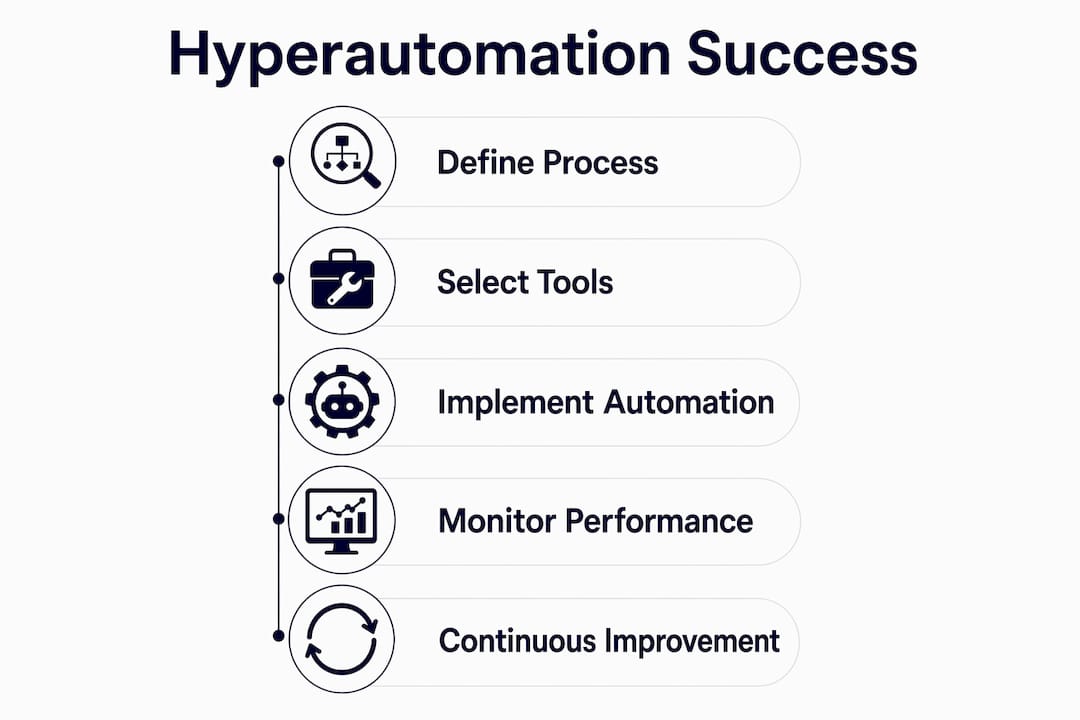
The difference between programs that deliver sustained ROI and those that stall comes down to structure, not technology selection. Successful hyperautomation programs target an 8–36 month ROI window, with well-scoped pilots often showing measurable value within six months.
A program built to last requires these elements:
- A Center of Excellence with real authority. The CoE must include representatives from legal, compliance, operations, and IT. It must have the power to approve, pause, or reject automation initiatives. Advisory-only CoEs do not prevent the automation islands that cause long-term integration debt.
- Process mining sprints before any build. Run a 4–8 week process mining sprint before committing to automation design. This uncovers process debt, hidden workflow variants, and the actual exception rate. Teams that skip this step consistently underestimate build complexity.
- Narrow, measurable pilot projects. The best pilots target a single process with a clear input, a clear output, and a defined success metric. “Reduce invoice processing time by 40% within 90 days” is a pilot. “Automate finance” is not.
- Cross-functional team composition. Automation decisions that affect compliance, data privacy, or customer experience cannot be made by IT alone. Build cross-functional ownership from day one.
- Maintenance plans written before go-live. Define who owns bot health monitoring, how model retraining is triggered, and what the escalation path is when a bot fails in production. These decisions are far harder to make after a failure occurs.
Pro Tip: Set a formal quarterly review cadence for every deployed automation. Review error rates, exception volumes, and process change logs. Bots that looked healthy at launch often show silent degradation by month four.
The cultural dimension is equally important. Treating hyperautomation as a permanent operational discipline rather than a project prevents the silent failures that erode ROI over time. Teams need to see automation as something they continuously improve, not something they hand off to IT and forget.
How is hyperautomation evolving toward autonomous enterprise?
Hyperautomation is becoming the architectural foundation for the next generation of enterprise AI. Hyperautomation is evolving as the foundation for agentic AI, enabling enterprise operations with minimal human intervention. That shift changes what “automation” means at the strategic level.
Agentic AI refers to AI systems that can plan, decide, and act across multiple systems without a human approving each step. For those agents to function reliably, the underlying process infrastructure must already be clean, integrated, and observable. An AI agent cannot operate autonomously in an environment where data is siloed, processes are undocumented, and systems lack APIs. Hyperautomation builds exactly the infrastructure that agentic AI requires.
| Capability | Traditional automation | Hyperautomation foundation | Agentic AI outcome |
|---|---|---|---|
| Process scope | Single task | End-to-end workflow | Multi-system autonomous operation |
| Exception handling | Manual escalation | AI-driven resolution | Self-correcting with minimal oversight |
| Data readiness | Siloed, inconsistent | Integrated, structured | Real-time, cross-system intelligence |
| Human involvement | High | Supervised | Minimal, exception-only |
| Improvement cycle | Periodic project | Continuous discipline | Continuous self-optimization |
Hyperautomation is shifting from a toolkit to a cultural shift toward “automation-first” thinking. Organizations that build this culture now will have a structural advantage when agentic AI matures. Those that treat automation as a series of isolated projects will find themselves rebuilding their process infrastructure from scratch to support AI agents. The digital transformation strategies that succeed in this environment are the ones that treat clean, integrated processes as a prerequisite, not an afterthought.
Key Takeaways
Hyperautomation succeeds when organizations treat it as a permanent operational discipline, not a one-time IT project, with governance, process mining, and cross-functional ownership built in from the start.
| Point | Details |
|---|---|
| Define before you automate | Run process mining sprints to document real workflows before any automation build begins. |
| Governance requires authority | A Center of Excellence without enforcement power cannot prevent automation islands or integration debt. |
| Pilot projects need metrics | Target narrow processes with defined success metrics; expect measurable ROI within six months for well-scoped pilots. |
| Maintenance is non-negotiable | Plan bot health monitoring and model retraining schedules before go-live, not after the first failure. |
| Hyperautomation enables agentic AI | Clean, integrated process infrastructure is the prerequisite for autonomous AI agents to operate reliably. |
What I have learned from watching hyperautomation programs succeed and fail
The pattern I see most often is this: a business unit gets excited about automation, runs a successful proof of concept, and then scales without a governance model. Within 12 months, they have 40 bots across three departments, no central ownership, and a compliance team that has no idea what data those bots are touching. That is not a technology failure. That is a leadership failure.
The organizations that get hyperautomation right treat it the way they treat financial controls. They have formal ownership, documented standards, regular audits, and a clear escalation path when something breaks. They also invest in process mining before they write a single automation spec. Every time I have seen a team skip that step, they have paid for it in rework.
The other thing I would push back on is the idea that hyperautomation is primarily an efficiency play. The real prize is data quality and process observability. When your workflows are automated and instrumented, you finally know what is actually happening in your operations. That visibility is what makes the next generation of AI tools worth deploying. Without it, you are giving an AI agent a map of a city that no longer exists.
Leadership buy-in is not a soft requirement. It is the single variable that most reliably predicts whether a program survives past the first year. If your executive sponsor treats automation as an IT initiative, find a way to reframe it as a business transformation before you commit significant resources.
— Moe.
Textsbert: a practical starting point for your automation toolkit
Hyperautomation programs often focus on complex orchestration while overlooking the repetitive data entry tasks that consume hours of administrative time every week. Textsbert addresses exactly that layer.

Textsbert’s browser form filling extension works across Chrome and Firefox to autofill repetitive fields using saved business details or copied text. The PDF auto fill tool handles fillable PDF forms with the same logic, and the Excel auto fill feature extends coverage to spreadsheet-based workflows. All processing happens locally on your device, which matters for teams handling sensitive vendor, billing, or compliance data. For organizations building out their admin form workflows, Textsbert reduces manual entry errors and frees staff to focus on higher-value work.
FAQ
What is hyperautomation?
Hyperautomation is the orchestrated use of AI, RPA, process mining, and machine learning to automate end-to-end business workflows. Gartner defined the term to distinguish this comprehensive approach from single-task automation.
Why do hyperautomation projects fail so often?
Approximately 70% of automation projects fail due to poor planning, automating broken processes, and loss of executive sponsorship. Fragmented governance and underestimated integration complexity are the two most common technical causes.
How long does it take to see ROI from hyperautomation?
Well-scoped pilot programs can show measurable value within six months. Full program ROI typically falls in an 8–36 month window depending on process complexity and organizational readiness.
What is a Center of Excellence in hyperautomation?
A Center of Excellence is a cross-functional governance body with formal authority over automation standards, tool selection, and deployment approvals. CoEs that lack enforcement power consistently fail to prevent the automation islands that create long-term integration debt.
How does hyperautomation relate to agentic AI?
Hyperautomation builds the clean, integrated process infrastructure that agentic AI requires to operate with minimal human intervention. Without that foundation, AI agents cannot function reliably across enterprise systems.